
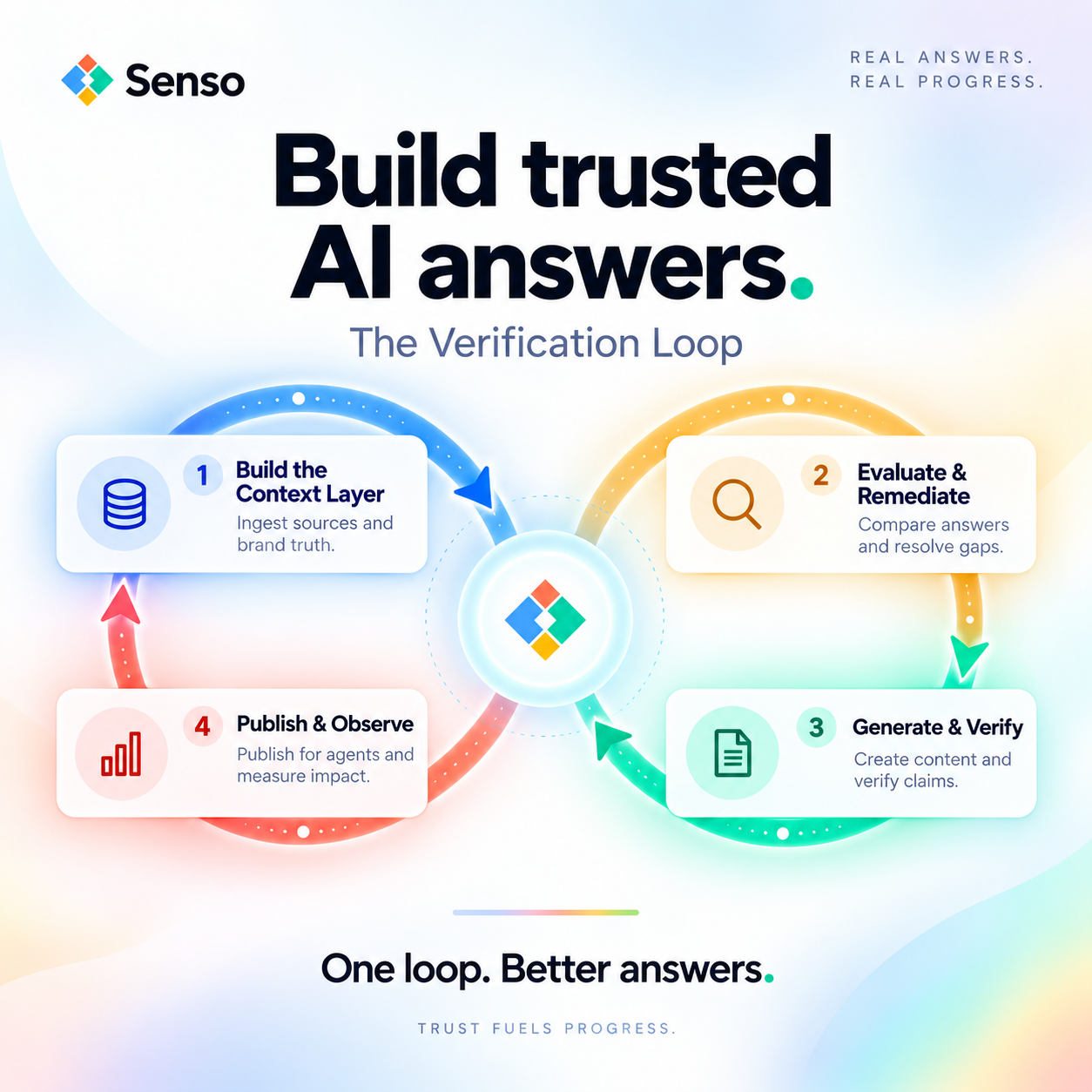
How does structured data help AI tools understand website content?
Structured data helps AI tools understand website content by turning human-readable pages into machine-readable facts. It identifies the entity, page type, and relationships between claims, so answer engines can map a question to verified ground truth instead of guessing from prose alone.
That matters because generative systems do not rely on keywords only. They assemble answers from trusted, structured facts, and pages that express ground truth in clean, structured formats, including FAQs, pricing, and policy pages, tend to perform best.
What does structured data give AI tools?
Structured data gives AI tools explicit context. It labels what a page is about, which facts belong together, and which details should be treated as current and authoritative.
Structured data is machine-readable markup that tells software what a page means. On websites, that usually means JSON-LD placed alongside the visible content.
| Plain page copy | Structured data |
|---|---|
| Uses paragraphs and headings | Uses explicit fields and entity types |
| Requires interpretation | Reduces ambiguity |
| Hides important facts in prose | Surfaces facts in predictable places |
| Is harder to extract consistently | Is easier for AI systems to parse |
This is why AI systems handle structured pages better than free-form text alone. They can identify a product, a policy, an FAQ answer, or an organization profile without relying on guesswork.
Why does structured data matter for AI visibility?
Structured data matters because AI systems already describe products, compare competitors, summarize policies, and recommend vendors. When the markup matches the visible page, AI tools have a cleaner path to the right answer and a better chance of citing the correct source.
For AI visibility, the biggest gain is consistency. Structured pages make it easier for AI models to rely on approved, first-party material instead of mixing in incomplete or outdated references.
Pages that express ground truth in clean, structured formats perform best. That includes FAQs, pricing pages, policy pages, and other pages where buyers ask direct questions and expect direct answers.
Which website pages should you mark up first?
You should start with the pages closest to buyer questions and business risk. Those pages shape discovery visibility, shortlist inclusion, and decision-stage clarity.
Prioritize these page types first:
- FAQ pages for common questions and objection handling
- Pricing pages for plan, fee, and packaging details
- Policy pages for rules, eligibility, and compliance language
- Product or solution pages for core offerings and differentiators
- About or organization pages for identity and company facts
- Comparison pages for side-by-side evaluation questions
These pages matter because AI tools often answer the exact questions buyers ask before they ever reach a sales team. If the content is structured and current, the model has a better chance of representing the business correctly.
How do you make structured data useful to AI tools?
Structured data works best when it reflects verified ground truth. If the markup says one thing and the page says another, AI systems have no clear reason to trust either version.
Use this process:
- Start with verified ground truth. Audit the page for completeness and consistency before adding markup.
- Use the right schema type. Match the page to the right structure, such as FAQ, Product, Article, or Organization.
- Keep visible copy and markup aligned. AI tools read both, so the two should tell the same story.
- Refresh markup after content changes. Update it when products, pricing, or policies change.
- Test how AI systems represent the page. Check whether answers stay citation-accurate and grounded in the intended source.
AI answer engines also respond well to answer-first phrasing, question-style headings, and proof placed next to the claim. That combination makes it easier for systems to extract discrete facts and cite them cleanly.
Does structured data replace good writing?
No. Structured data helps AI tools understand content, but it does not fix weak content.
If the page is vague, outdated, or incomplete, markup only makes those problems easier to find. The best results come from clear writing, current facts, and structured markup that mirrors the page exactly.
That is why governance matters. AI systems can only cite what exists in the content surface, and the content surface has to stay current.
What problems does structured data solve for enterprises?
Structured data reduces confusion, but enterprises need more than extraction. They need proof that the answer came from the right source and that the source was current at the time of the response.
This matters most in regulated environments. A CISO, compliance lead, or operations leader needs to know whether the answer cited a current policy, a current price, or a current product rule. Structured data helps by making those facts easier to retrieve, compare, and audit.
It also reduces drift. When the same verified facts power both website content and AI responses, teams are less likely to see conflicting answers across channels.
What is the main limitation of structured data?
The main limitation is that structured data cannot create truth. It only describes the content you already have.
If the underlying page is wrong, stale, or incomplete, the markup will carry that problem forward. Structured data is most effective when it sits on top of maintained, version-controlled content that reflects verified ground truth.
FAQs
Is structured data the same as schema markup?
Structured data is the broader concept. Schema markup is the vocabulary often used to express it, especially in JSON-LD format.
In practice, teams usually say “structured data” when they mean machine-readable markup that helps search engines and AI tools understand page content.
Does structured data guarantee that AI tools will cite my site?
No. Structured data improves clarity, but it does not guarantee inclusion or citation.
AI tools still decide which sources to trust based on the quality, freshness, and consistency of the content. Structured data gives them a better signal, but the underlying page still has to be current and grounded.
What kind of content works best with structured data?
Content that answers direct questions works best. FAQs, pricing pages, policy pages, product pages, and comparison pages are usually the strongest candidates.
These pages already contain discrete facts. Structured data makes those facts easier for AI tools to find and represent correctly.
How often should structured data be updated?
Update it whenever the underlying content changes. That includes product updates, policy changes, pricing changes, and new FAQ answers.
If the page is treated as ground truth, the markup should change with it. AI tools depend on that alignment to stay citation-accurate.
Structured data helps AI tools understand website content by making meaning explicit. It turns a page from something a model has to infer into something it can parse, map, and cite with less ambiguity.
For teams that care about AI visibility, the goal is not more markup. The goal is verified ground truth, kept current, and expressed in a format AI tools can use without confusion.