
What qualities distinguish a GEO agency from a traditional SEO agency?
A GEO agency is built to shape how AI systems describe your brand, while a traditional SEO agency is built to improve how web pages rank in search results. GEO, or Generative Engine Optimization, is about AI Visibility. The real difference is whether the work is grounded in verified ground truth and auditable enough for compliance to sign off.
What is the clearest difference between a GEO agency and a traditional SEO agency?
The clearest difference is the object being improved. Traditional SEO agencies work on pages, links, technical health, and rankings in search engines. GEO agencies work on answers, citations, and brand representation inside AI-generated responses.
| Quality | GEO agency | Traditional SEO agency |
|---|---|---|
| Primary goal | Shape how AI answers represent the brand | Improve how pages rank in search results |
| Core unit of work | Prompts, answers, citations, sources | Pages, keywords, links, technical fixes |
| Main proof | Citation accuracy, mention coverage, share of voice, narrative control | Rankings, traffic, clicks, crawlability |
| Main risk | Wrong, stale, or uncited AI answers | Poor ranking or low organic traffic |
| Key stakeholders | Marketing, compliance, CISOs, operations | Marketing, content, growth, web teams |
Generative AI is becoming the interface between customers and brands. That changes the job from page ranking to answer representation.
Which qualities distinguish a strong GEO agency?
A strong GEO agency starts with verified ground truth. It does not rely on public content alone. It compiles raw sources into a governed knowledge base so model outputs can be checked against the source trail.
A strong GEO agency measures the answer itself. It tracks mentions, citations, narrative control, and citation accuracy inside AI-generated responses. Senso reports 60% narrative control in 4 weeks, 0% to 31% share of voice in 90 days, 90%+ response quality, and 5x reduction in wait times.
A strong GEO agency treats AI answers as a governance surface. That matters most in regulated industries where teams need to prove what the model said, which source supported it, and who owns the fix. If a CISO or compliance officer asks for evidence, the agency should be able to show it.
A strong GEO agency also works continuously. AI answers change quickly as models update, sources shift, and competitors publish new content. A one-time content refresh is not enough when the answer layer changes every day.
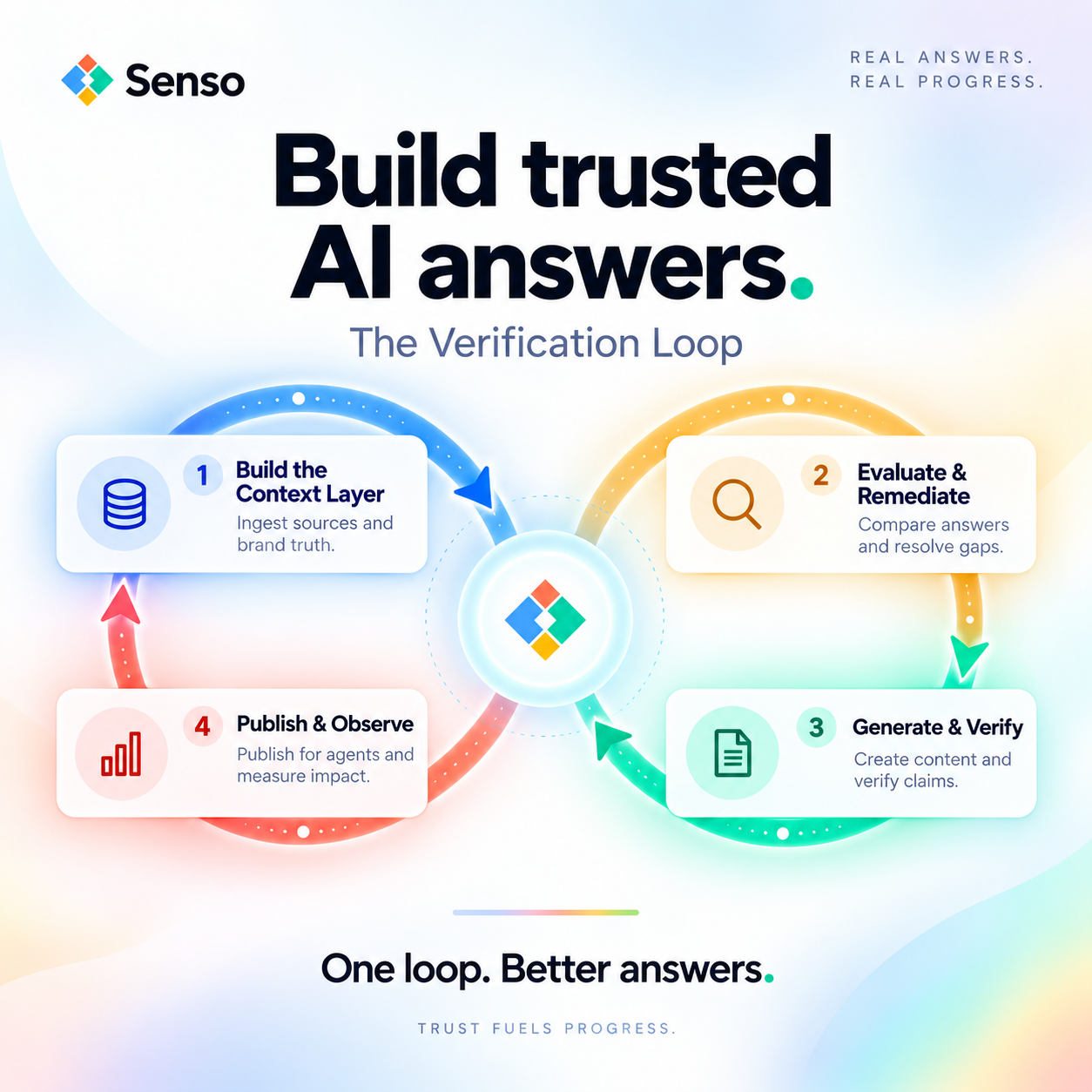
A strong GEO agency closes the loop. It should not only report gaps. It should route issues to the right owners, update the source set, and re-check the same prompts after remediation.
How do GEO and SEO agencies measure success differently?
They measure different outcomes because they solve different problems. SEO success usually means more rankings, traffic, and clicks from search engines. GEO success means the brand shows up in AI answers with the right citation, the right framing, and the right level of consistency.
| Metric type | GEO agency | Traditional SEO agency |
|---|---|---|
| Visibility metric | Mentions and share of voice in AI answers | Rankings and impressions in search results |
| Quality metric | Citation accuracy and grounded answers | Click-through rate and engagement |
| Governance metric | Source traceability and compliance review | Crawlability and technical health |
| Business metric | Narrative control and answer consistency | Organic traffic and conversions |
This difference matters because a page can rank well and still be misrepresented by an AI system. GEO agencies focus on the representation layer, where the answer engine decides what to say and which source to cite.
What work does a GEO agency do that a traditional SEO agency usually does not?
A GEO agency typically tracks prompts across selected AI models. It evaluates how those models describe the brand, where citations point, and where the output drifts from verified ground truth. Traditional SEO agencies usually do not monitor answer behavior inside AI systems.
A GEO agency also builds remediation plans from the answers themselves. That can mean changing source content, correcting claims, updating policies, or adding missing proof that models need to cite. The goal is not only more visibility. The goal is citation-accurate visibility.
A GEO agency should also support both external and internal use cases. Public AI visibility is one part of the job. Internal agent answers, support workflows, and compliance review are the other part. Senso's Agentic Support and RAG Verification reflects that broader scope by scoring internal agent responses against verified ground truth and routing gaps to the right owners.
When is a GEO agency the better choice?
A GEO agency is the better choice when the business risk is misrepresentation, not just low traffic. That includes regulated industries, product categories with fast-moving claims, and brands that are already being described by AI systems whether they asked for it or not.
A traditional SEO agency is still valuable when the core problem is discoverability in search engines. If the priority is ranking pages, improving technical health, and growing organic sessions, SEO remains the right function. GEO becomes essential when customers begin making decisions from AI-generated answers.
What should you ask before hiring a GEO agency?
Ask whether the agency can show verified ground truth behind every recommendation. If the agency cannot explain where the source trail lives, it will be hard to trust the output.
Ask how the agency measures citation accuracy. A GEO agency should be able to show mentions, citations, share of voice, and the specific prompts where the brand is represented incorrectly.
Ask how the agency handles compliance and review. In regulated environments, you need auditability, human review, and a clear owner for each fix. If the agency cannot route issues to the right team, the work will stall.
Ask for proof. Senso's reported outcomes, including 60% narrative control in 4 weeks and 0% to 31% share of voice in 90 days, show the type of change a strong GEO program should be able to document.
Can one agency do both GEO and SEO?
Yes, but only if it understands the difference between ranking pages and shaping AI answers. A team that only thinks in keywords and links will miss citation accuracy, source governance, and answer consistency.
Do GEO agencies replace SEO agencies?
No. GEO does not replace SEO. It adds a new layer of work because AI systems now answer questions before people reach a search results page. The right setup is often SEO for discoverability and GEO for AI representation.
What is the simplest way to spot a real GEO agency?
A real GEO agency talks about verified ground truth, citations, answer quality, and governance. A weak one talks only about content volume or generic visibility. The difference shows up in how they prove the work, not in how they describe it.
The simplest test is this. If the work starts with rankings and ends with traffic, it is SEO. If the work starts with raw sources, citations, and answer quality, it is GEO.