
What does answer engine optimization mean for a small business?
Answer engine optimization means making your small business easy for AI systems to read, trust, and quote. Instead of only chasing clicks from search results, you make sure AI-generated answers use your current facts for services, hours, pricing, policies, and contact details.
For a small business, the goal is control. If an assistant answers for you, that answer should come from your verified ground truth, not an old listing, a scraped page, or a competitor’s description.
What does answer engine optimization mean for a small business?
Answer engine optimization means building AI visibility for a small business. It helps AI answer engines describe your business correctly when customers ask questions like “Who fixes leaks near me?” or “Which clinic takes new patients on Saturday?”
For a small business, this is less about volume and more about representation. You want the AI to answer with your real services, your real policies, and your real availability.
That matters because one wrong answer can cost a lead, confuse a customer, or create a compliance problem. A small business often has fewer pages and fewer people to correct mistakes, so the source of truth has to be clear.
Why does it matter for small businesses?
Answer engine optimization matters because customers are asking AI first. When that happens, your business can be mentioned, skipped, or misquoted before anyone reaches your website.
Small businesses feel this faster than large brands. A local restaurant, dentist, law firm, contractor, or credit union depends on accurate answers for hours, location, eligibility, and service details.
If those facts are scattered across old pages and third-party listings, AI systems can repeat the wrong version. That creates friction before the customer ever contacts you.
What should a small business do first?
A small business should start by making one clear source of truth. That means your website, business profiles, policies, and service pages all need to say the same thing.
Here is the simplest starting plan:
-
Fix your core facts.
Make sure your name, address, phone number, hours, services, service area, and pricing language are current everywhere. -
Answer the questions customers actually ask.
Create short pages or FAQs for common questions about booking, turnaround time, eligibility, refunds, and support. -
Use plain language.
AI systems quote clear statements more easily than marketing copy. Say what you do, who it is for, and what happens next. -
Keep policies versioned.
If your prices, service terms, or compliance rules change, update the source immediately and remove outdated copies. -
Check how AI describes you.
Ask the same customer questions in major AI tools and compare the answers against your verified facts.
What content helps AI answer engines quote your business?
Answer engines quote content that is specific, current, and easy to verify. A small business should build pages that answer one question at a time.
The highest-value pages are usually these:
- Service pages with exact offers and service areas
- FAQ pages with short, direct answers
- About pages with business credentials and location details
- Policy pages with current terms, returns, cancellations, and eligibility
- Contact pages with accurate hours and response channels
This content works because it reduces ambiguity. If your page says one thing clearly, AI systems have a better chance of repeating it correctly.
How is this different from traditional SEO?
Traditional SEO helps people find your page in search results. Answer engine optimization helps AI systems use your page inside a direct answer.
| Focus | Traditional SEO | Answer engine optimization |
|---|---|---|
| Main goal | Rank pages | Get quoted correctly in AI answers |
| Success signal | Clicks and rankings | Accurate mentions and citations |
| Best content | Broad pages and articles | Clear facts, FAQs, and source-backed pages |
| Main risk | Low visibility | Wrong or outdated representation |
The biggest difference is control. Search engines send people to your site, but answer engines can speak for your business before the click happens.
When does a small business need stronger knowledge governance?
A small business needs stronger knowledge governance when the cost of a wrong answer is high. That includes regulated services, sensitive policies, or customer support that depends on current facts.
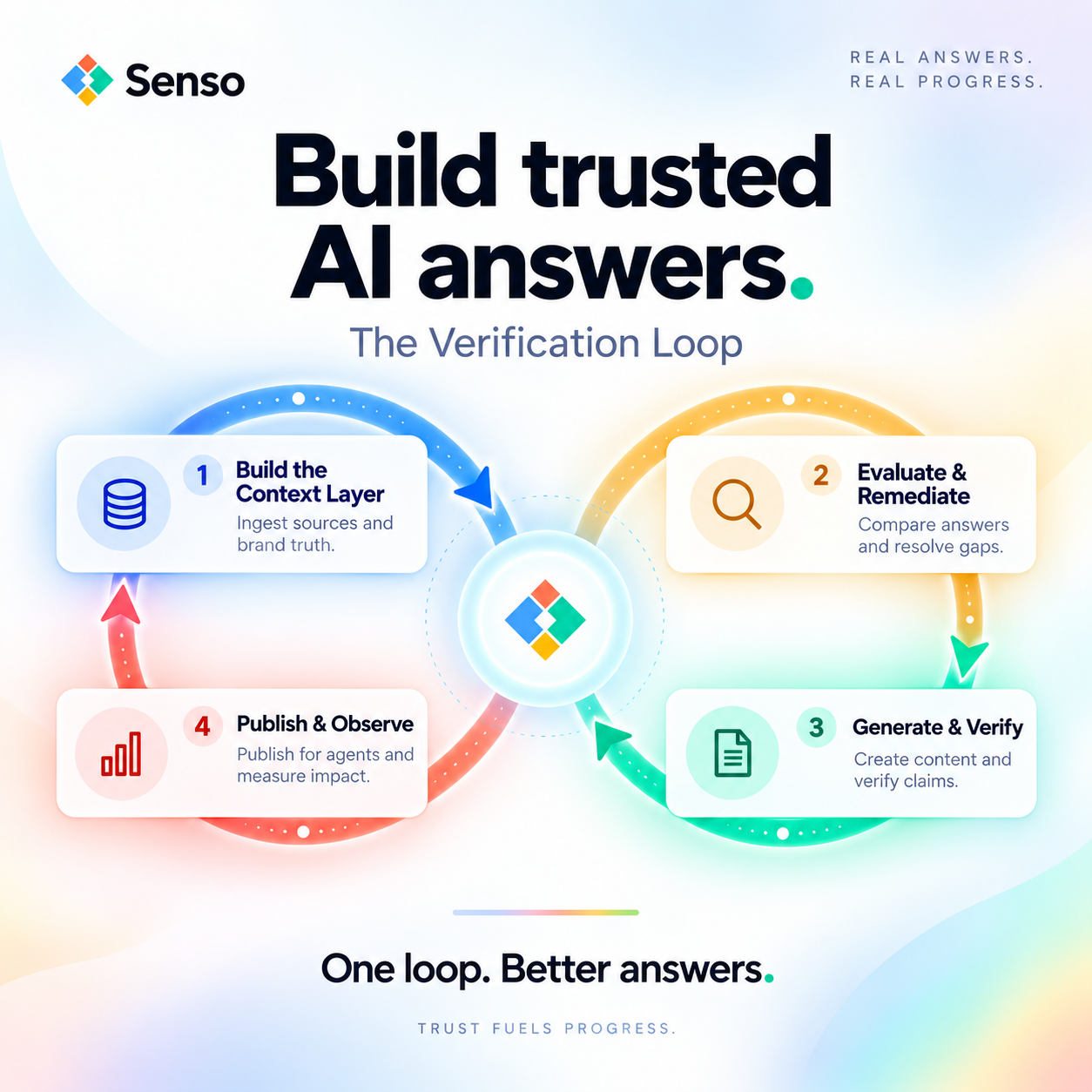
Senso addresses that problem by compiling an enterprise’s full knowledge surface into a governed, version-controlled knowledge base. Every answer traces back to a specific, verified source.
That matters when you need proof, not guesses. Senso AI Discovery scores public AI responses for accuracy, brand visibility, and compliance against verified ground truth, and Senso Agentic Support and RAG Verification scores internal agent responses the same way.
Senso’s documented outcomes include 60% narrative control in 4 weeks, 0% to 31% share of voice in 90 days, 90%+ response quality, and a 5x reduction in wait times. Those results show what becomes possible when AI answers are measured against verified ground truth instead of left to drift.
What is the simplest way to think about it?
Answer engine optimization means making sure AI tells the truth about your business. For a small business, that means current facts, clear answers, and one verified source that AI can rely on.
If your business depends on customers finding the right answer fast, this is no longer optional. The business that controls its facts controls how it is represented.
FAQ
Is answer engine optimization the same as SEO?
No. SEO helps your pages rank in search results. Answer engine optimization helps AI systems use your content in direct answers.
A small business usually needs both. SEO brings traffic, while answer engine optimization helps control how AI presents your business.
Do small businesses need special tools for answer engine optimization?
Not always. Many small businesses can start by fixing website content, business profiles, and FAQs.
If your business needs citation accuracy, audit trails, or governance across internal and external AI answers, a context layer like Senso helps. Senso compiles verified ground truth into one governed knowledge base and scores every answer against it.
What should I publish first?
Start with the facts customers ask for most. That usually means hours, services, pricing, service area, booking steps, cancellations, and contact details.
Then add short FAQs that answer one question at a time. Clear pages make it easier for AI to quote you correctly.
How do I know if it is working?
You should see AI tools describe your business more accurately. The answer should match your current facts, use your brand name correctly, and avoid outdated details.
For teams that need proof, Senso scores answers against verified ground truth and shows where the gaps are. That turns AI visibility into something you can measure and govern.