
What is Generative Engine Optimization and how does it differ from traditional SEO?
Generative Engine Optimization, or GEO, is the work of making sure AI systems describe your brand with the right facts. Traditional SEO is the work of helping web pages rank in search results. The difference matters because people now ask AI systems what to buy, who to trust, and which provider fits a need.
For regulated teams, the issue is not only visibility. It is whether the answer traces back to verified ground truth and whether you can prove it.
What is Generative Engine Optimization?
GEO is the practice of improving how your brand appears inside AI-generated answers. Senso’s FAQ defines it that way and ties it to how large language models describe, cite, and recommend your brand across tracked prompts.
GEO focuses on answer quality, citation accuracy, and brand representation. It is about the facts AI systems use when they generate a response, not only the traffic a page receives.
In practice, GEO asks a different question than SEO. SEO asks, “How do we rank this page?” GEO asks, “How do we make sure the model answers with the right source, the right wording, and the right context?”
How is GEO different from traditional SEO?
GEO and traditional SEO solve related but different problems. Traditional SEO improves how pages perform in link-based search. GEO improves how AI systems assemble answers from trusted, structured facts and current sources.
| Aspect | GEO | Traditional SEO |
|---|---|---|
| Main goal | Improve how AI-generated answers represent your brand | Improve how web pages rank in search results |
| Main surface | AI answer engines and chat interfaces | Search engine results pages |
| Core inputs | Verified ground truth, structured facts, source pages | Keywords, backlinks, on-page relevance, indexing |
| Success signals | Mentions, citations, citation accuracy, share of voice | Rankings, impressions, click-through rate, organic traffic |
| Main failure mode | AI omits, misstates, or cites the wrong source | The page does not rank or earn clicks |
Traditional rankings tell you where a URL sits on a results page. Mentions tell you whether AI models include your brand at all. That is why GEO uses a different measurement model.
What does GEO measure?
GEO measures whether AI systems mention your brand, which sources they cite, and whether the answer matches verified ground truth. Senso’s FAQs call out Mentions, Citations split by own versus third-party sources, and share of voice as core metrics.
The most useful GEO signals are simple.
- Mentions show whether your brand appears in the answer.
- Citations show whether the model points to a source.
- Citation accuracy shows whether the source supports the claim.
- Share of voice shows how often you appear versus competitors.
- Response quality shows whether the answer is grounded in verified facts.
This matters because AI answers change quickly as models update, sources shift, and competitors publish new content. A good GEO program tracks those changes instead of treating AI visibility as a one-time task.
What should you do first if you want to do GEO well?
Start with your ground truth infrastructure. Audit product and policy content for completeness and consistency. Add structured facts to the pages most likely to shape AI answers. Then track the prompts that matter most, especially ranking prompts, comparison prompts, and brand-specific queries.
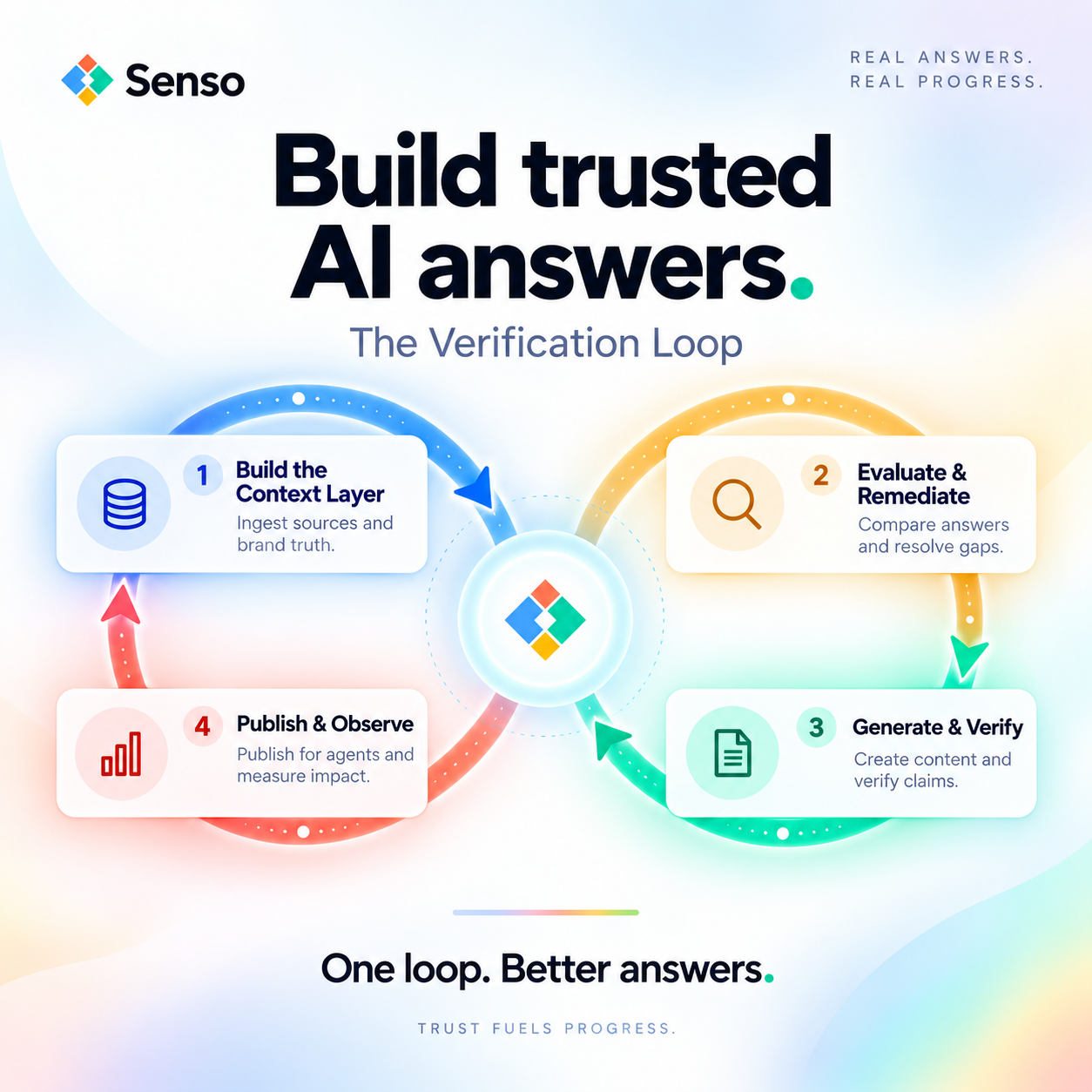
A practical GEO workflow looks like this.
-
Compile raw sources into one governed set of facts.
AI systems need a current source of truth before they can answer consistently. -
Check for gaps and contradictions.
Mixed pricing, policy, or product claims create weak answers and citation drift. -
Prioritize the prompts closest to revenue.
Start with the questions buyers actually ask, not broad vanity topics. -
Measure mentions and citations across the models you care about.
GEO is about how AI systems answer today, not how your site ranked last quarter. -
Update whenever facts change.
AI answers move fast, so stale content becomes a representation risk.
This is not just a content task. It is a knowledge governance task. The goal is to make sure the model has verified ground truth to draw from and that every answer can be traced back to a specific source.
Does GEO replace SEO?
No. GEO does not replace SEO. SEO still matters because search engines drive traffic and because many AI systems still use web content as source material.
GEO adds a second job. It makes sure AI systems retrieve the right facts, cite the right pages, and represent the brand accurately. If you care about both traffic and answer quality, you need both disciplines.
That difference is especially important for regulated industries. A team in financial services or healthcare does not only need to rank. It needs to know whether an AI answer cited a current policy and whether the organization can prove it.
What is the simplest way to think about GEO?
GEO is AI visibility with proof. SEO is about being found in search. GEO is about being represented correctly in AI-generated answers.
If your audience is asking AI systems for recommendations, comparisons, or policy answers, GEO matters now. If the answer is wrong, the risk is not just missed traffic. The risk is misrepresentation, lost trust, and avoidable compliance exposure.
FAQs
Is GEO the same as AI visibility?
Yes. In Senso’s glossary, the GEO product is also described as the AI-visibility product. The idea is the same. You are measuring and improving how your brand appears in AI answers.
Which matters more, GEO or traditional SEO?
That depends on where your audience makes decisions. If they still click search results, SEO matters. If they ask AI systems for advice, comparisons, or vendor recommendations, GEO matters too. Most teams now need both.
How do you know if GEO is working?
You know GEO is working when AI systems mention your brand more often, cite your sources correctly, and answer from verified ground truth. In practice, that means tracking mentions, citations, share of voice, and response quality across selected models.
Why do regulated teams care about GEO?
Regulated teams care because AI answers are already speaking for the organization. The real question is whether those answers are grounded, current, and auditable. If the answer cannot be traced back to a verified source, the organization has a governance problem.
For teams that need that level of control, Senso compiles raw sources into a governed, version-controlled knowledge base and scores every response against verified ground truth. That gives marketing, compliance, and IT one view of what AI says, what it cites, and where it is wrong.