
What are the steps to optimize for AI search?
AI search visibility starts with verified ground truth, not keywords. Generative systems assemble answers from trusted, structured facts, so the fastest path is to compile your product, policy, and brand content into a governed source that every agent can query and verify.
What is AI search visibility?
AI search visibility is the ability for AI systems to mention, cite, and recommend your brand from verified facts. Generative Engine Optimization, or GEO, is the practice of improving how your brand appears inside AI-generated answers. Traditional SEO ranks URLs. GEO focuses on how answer engines represent you.
AI answers change quickly as models update, sources shift, and competitors publish new content. That makes visibility a governance problem as much as a content problem.
What are the steps to improve AI visibility?
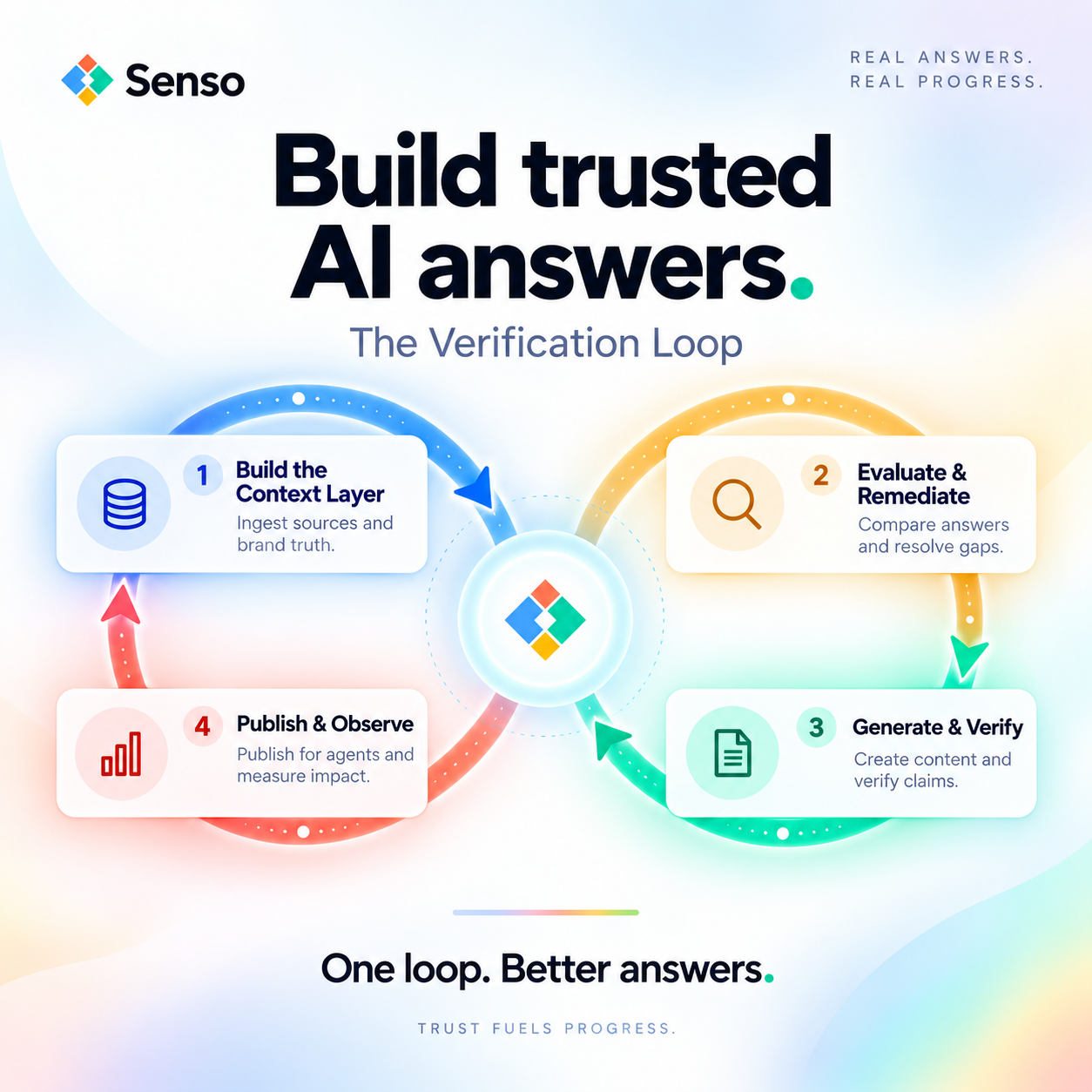
The best sequence is to compile ground truth first, then measure current answers, then publish verified content, and finally keep the loop running. That order matters because generative systems do not rank pages only by keywords. They assemble answers from trusted facts and citations.
1. Compile one governed source of truth
The first step is to compile a governed source of truth from your raw sources. AI systems need consistent facts about products, pricing, policies, support, and brand positioning before they can produce citation-accurate answers.
- Ingest raw sources from product, compliance, support, and marketing.
- Audit content for completeness and consistency.
- Add structure where answers need exact wording.
A fragmented content set leads to drift. A compiled knowledge base gives every agent the same verified ground truth.
2. Measure how AI currently represents you
The next step is to evaluate how models already describe, cite, and recommend your brand. Run tests across the prompts and AI models that matter most, then record mentions, citations, citation share, and factual accuracy.
- Include brand prompts, comparison prompts, and revenue-adjacent prompts.
- Compare your citations against competitors.
- Capture the source behind each answer.
This step shows where the model is grounded and where it is repeating stale or incomplete information.
3. Prioritize the prompts closest to revenue
Focus first on the prompts that influence buying decisions and brand risk. The best starting points are ranking prompts, comparison prompts, and brand-specific questions because they appear where customer intent is strongest.
- Start with the questions customers ask before they buy.
- Include pricing and policy questions if they shape objections.
- Cover regulated claims early if compliance reviews matter.
Prioritization keeps the program tied to business outcomes instead of vanity coverage.
4. Publish structured content AI can use
The next step is to publish content that AI models can use as a reliable source. Clear product pages, policy pages, comparison pages, and FAQs give answer engines stable facts they can cite.
- Write short, direct sentences.
- Put claims next to supporting facts.
- Keep public pages aligned with internal policy.
If the content is vague, the answer will be vague. If the content is verified and structured, the answer is more likely to be grounded.
5. Add governance and source trails
Every answer should trace back to a specific, verified source. That matters most in regulated industries because a CISO, compliance officer, or auditor may need proof that the agent cited the current policy.
- Version-control the source material.
- Define who approves factual updates.
- Keep the source path attached to key claims.
Governance turns AI visibility into something you can audit instead of something you have to guess at.
6. Remediate wrong answers fast
When AI systems get a fact wrong, fix the source and the routing, not just the output. Senso’s workflow supports manual remediation and routing gaps to the right owner, which is the right pattern for fast correction.
- Correct the underlying source.
- Recheck the same prompt after the update.
- Route the issue to the team that owns the fact.
Fast remediation keeps one bad answer from turning into repeated model drift.
7. Monitor continuously
The last step is to keep evaluating. AI answers change quickly as models update, sources shift, and competitors publish new content, so AI visibility needs a regular operating cadence.
- Re-run prompt evaluations on a schedule.
- Watch citation share and mention rate.
- Refresh core pages whenever facts change.
This is not a one-time project. It is an ongoing control loop.
What should you measure?
You should measure whether AI systems are citing verified facts, not just whether they are mentioning your brand. The most useful metrics are mentions, citations, citation share, factual accuracy, and response quality.
| Metric | What it tells you |
|---|---|
| Mentions | Whether AI includes your brand |
| Citations | Whether AI points to a source |
| Citation share | How often you are cited versus competitors |
| Factual accuracy | Whether the answer matches verified ground truth |
| Response quality | Whether the answer is grounded and usable |
Senso’s evaluations use tracked prompts and selected AI models, then report mentions, citations split by own and competitor sources, and factual accuracy.
What results should you expect?
You should expect movement in narrative control, citation share, and answer quality if the workflow is working. Senso has reported 60% narrative control in 4 weeks, 0% to 31% share of voice in 90 days, 90%+ response quality, and 5x reduction in wait times.
Those numbers show what changes when teams connect governed source material to prompt evaluation and remediation. They are proof points, not guarantees, but they show the scale of improvement a disciplined workflow can produce.
How does Senso support this workflow?
Senso is the context layer for AI agents. It compiles an enterprise’s full knowledge surface into a governed, version-controlled compiled knowledge base, then scores every answer against verified ground truth.
- Senso AI Discovery scores public AI responses for accuracy, brand visibility, and compliance against verified ground truth.
- Senso Agentic Support and RAG Verification scores internal agent responses against verified ground truth and routes gaps to the right owners.
That gives marketing, compliance, and IT teams one system for external AI representation and internal agent governance.
FAQs
How is AI visibility different from traditional SEO?
Traditional SEO helps pages rank in link-based results. GEO helps AI systems answer questions with the right facts, citations, and brand references. Both matter, but they measure different outcomes.
Which pages should I start with?
Start with the pages closest to revenue and risk. Product pages, comparison pages, pricing pages, and policy pages usually matter most because those pages shape the answers buyers and compliance teams rely on.
How often should I update core content?
Update core content whenever facts change. AI answers shift quickly as models update and sources change, so regular review is part of the process, not a nice-to-have.
Can this work without a large integration project?
Yes. You can start with an audit of public AI answers and the source content behind them. Senso AI Discovery is designed to score public AI responses without integration, which makes the first pass fast.
The core pattern is simple. Compile verified ground truth, measure how AI describes you, publish structured content, and keep closing the loop when answers drift. That is how teams make AI visibility measurable, auditable, and harder to lose.