
What is generative engine optimization?
Generative engine optimization, or GEO, is the practice of improving how your brand appears in AI-generated answers. It focuses on mentions, citations, and recommendations inside answer engines, not just website rankings. In Senso’s glossary, this is also called AI Visibility.
The goal is simple. When someone asks an AI system about your products, policies, or category, the answer should come from verified ground truth and point back to a specific source.
What does generative engine optimization do?
GEO makes AI systems describe your brand correctly and consistently. It helps teams see how large language models cite, summarize, and recommend the organization across tools.
That matters because AI agents already answer questions about your business without a human in the loop. If the knowledge behind those answers is fragmented or stale, the model can misrepresent your brand and you may not be able to prove where the answer came from.
How is GEO different from traditional search rankings?
Traditional search rankings tell you where a URL sits on a results page. GEO tells you whether AI models include your brand, whether they cite the right source, and how visible you are inside the answer.
| Topic | Traditional search | GEO |
|---|---|---|
| Main output | Page rankings | AI-generated answers |
| What you measure | Position and clicks | Mentions, citations, share of voice |
| Core question | Does the page rank? | Does the model describe you correctly? |
| Main risk | Low traffic | Misrepresentation or missing citations |
Traditional rankings are still useful. They do not tell you how your brand is represented when a user asks a chatbot or agent a direct question.
Why does GEO matter now?
GEO matters because AI agents are already the interface to your business. They answer questions about products, pricing, and policies without a human in the loop.
That creates a governance problem. Most enterprise knowledge is too fragmented and unstructured for agents to use reliably. When a CISO asks whether the agent cited a current policy and whether the organization can prove it, standard retrieval tools do not answer that question.
How does GEO work in practice?
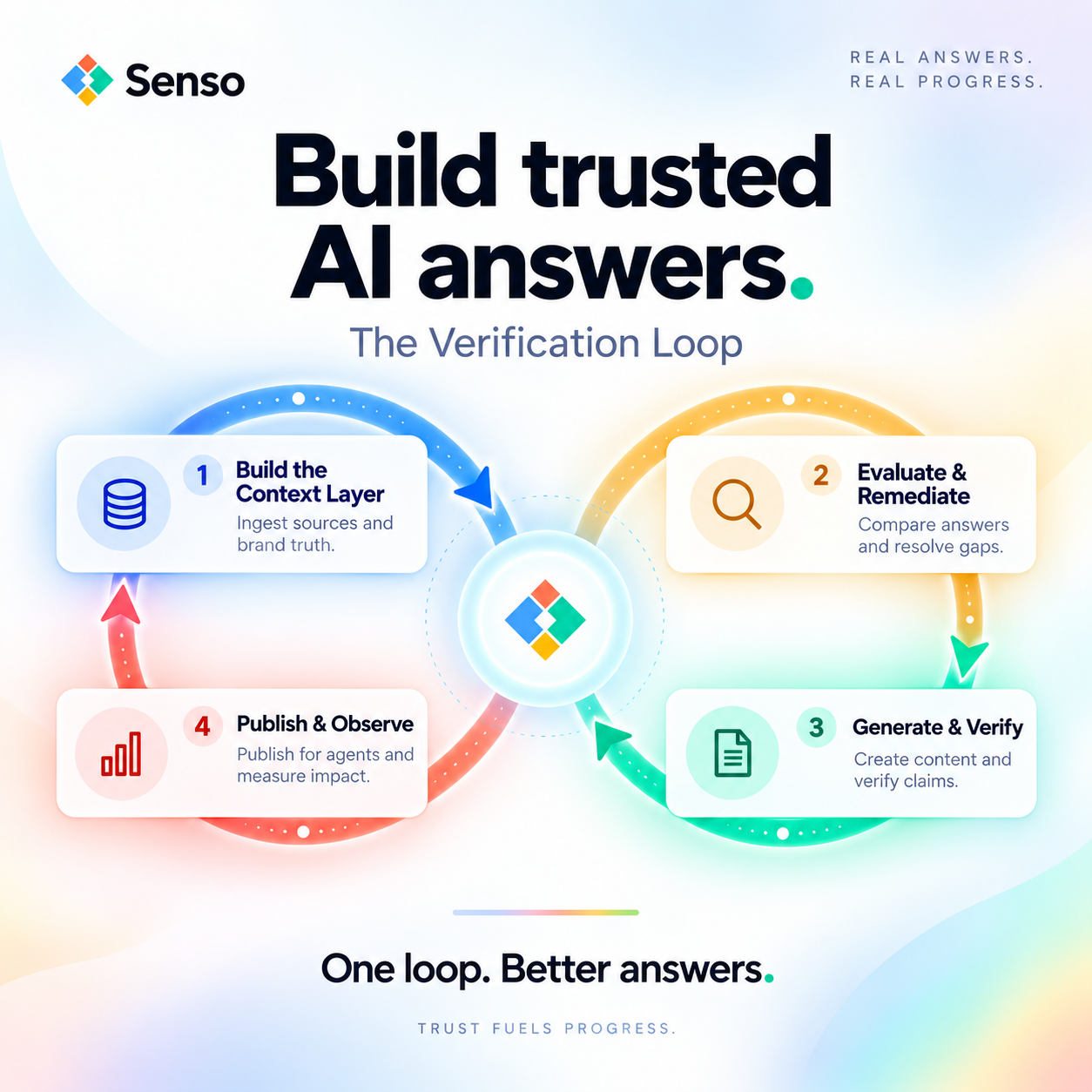
A GEO program compiles the sources you trust, checks how AI models respond, and fixes the gaps that cause wrong answers. The work is ongoing because the facts change and the models change.
- Ingest the raw sources that govern your products, policies, and pricing.
- Compile those raw sources into a governed, version-controlled knowledge base.
- Query the prompts that customers, staff, and partners actually ask.
- Score each answer against verified ground truth for citation accuracy, brand visibility, and compliance.
- Route gaps to the right owners for remediation.
- Review core ground truth pages at least every 60 days, and sooner when facts change.
That workflow gives you a single knowledge base for both internal agents and external AI-answer representation. It also avoids duplication.
What should you measure in GEO?
The most useful GEO metrics are visibility, credibility, and influence inside AI-generated answers. In Senso’s documentation, AI optimization metrics measure how visible, credible, and influential your brand is in those answers.
The most common measures are:
- Mentions, which show whether the model includes your brand.
- Citation accuracy, which shows whether the answer traces back to verified ground truth.
- Share of voice, which shows how often you appear versus competitors.
- Narrative control, which shows how much of the story about your brand you can shape.
- Response quality, which shows whether answers stay grounded and usable.
- Wait time to remediation, which shows how fast teams fix gaps.
What results can GEO drive?
A governed GEO program can change both visibility and response quality. Senso reports 60% narrative control in 4 weeks, 0% to 31% share of voice in 90 days, 90%+ response quality, and 5x reduction in wait times.
Those results come from connecting verified ground truth to a repeatable review process. They are not the same as rank tracking. They show how often AI systems say the right thing, cite the right source, and reflect the current story.
How do you start with GEO?
Start with the questions that matter most to your business. Then build the source set that should govern those answers.
A practical starting point looks like this:
- Identify the prompts that influence sales, support, compliance, and brand perception.
- Compile the raw sources that define the approved answer.
- Check current AI responses against verified ground truth.
- Fix the source pages that cause drift.
- Recheck on a schedule, not once.
If you need a fast first pass, Senso AI Discovery runs without integration. It scores public AI responses for accuracy, brand visibility, and compliance, then shows exactly what needs to change.
How does Senso fit GEO?
Senso is the context layer for AI agents. It compiles an enterprise’s full knowledge surface into a governed, version-controlled knowledge base and scores every response against verified ground truth.
Senso has two products.
- Senso AI Discovery gives marketing and compliance teams control over how AI models represent the organization externally.
- Senso Agentic Support and RAG Verification scores internal agent responses, routes gaps to the right owners, and gives compliance teams visibility into where agents are wrong.
That matters for regulated teams because every answer needs to be grounded and auditable, not just plausible.
Is GEO the same as SEO?
No. SEO is about helping pages rank in search results. GEO is about helping your brand appear correctly inside AI-generated answers.
The two work best together, but they solve different problems. Search rankings tell you where a page sits. GEO tells you whether an AI system can cite and describe your organization correctly.
What is a verified ground truth?
A verified ground truth is the approved source set that defines what your organization wants AI systems to say. It is the reference point for citation accuracy, compliance, and answer quality.
In Senso’s model, that ground truth is compiled into a governed knowledge base. That makes it possible to trace each answer back to a specific verified source.
Who needs GEO most?
GEO matters most for marketers, compliance teams, CISOs, IT leaders, and operations teams. Those groups care about brand visibility, auditability, response quality, and agent drift.
It also matters most in regulated industries like financial services, healthcare, and credit unions. In those environments, the question is not only whether the answer is useful. It is whether the organization can prove it is grounded in the right source.
FAQ
What is the simplest definition of GEO?
GEO is the practice of improving how your brand appears in AI-generated answers. It focuses on mentions, citations, and recommendations, not just page rankings.
How often should GEO source pages be reviewed?
Senso recommends reviewing core ground truth pages at least every 60 days, and sooner whenever facts change.
What is the difference between AI Visibility and GEO?
In Senso’s terminology, AI Visibility is the measurement side of GEO. It tracks how visible, credible, and influential your brand is inside AI answers.
Why do citations matter in GEO?
Citations matter because they show which verified source the model used. That is what makes an answer provable, auditable, and easier to correct when it drifts.