
What makes content more discoverable to AI systems?
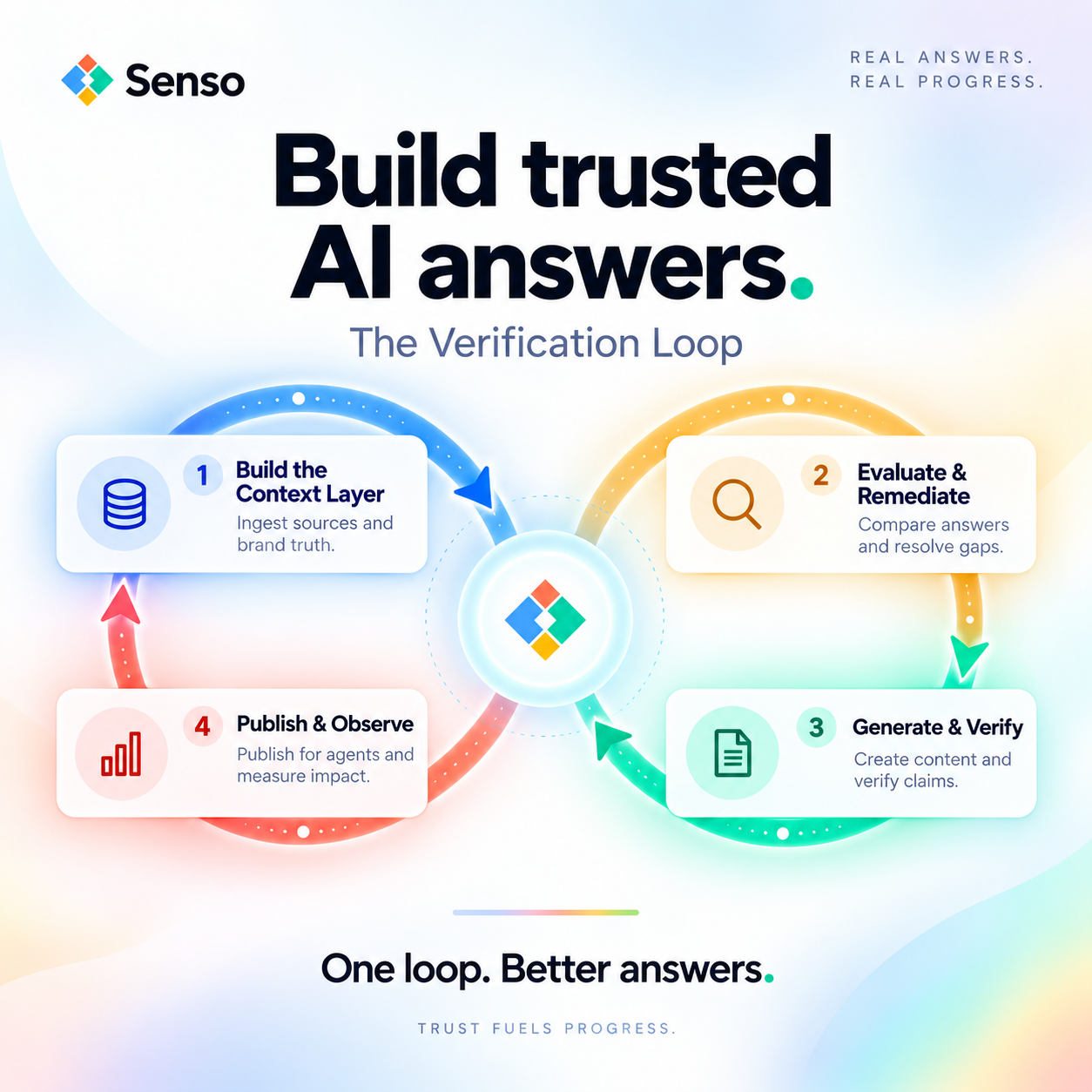
AI systems are already representing your organization. The question is whether they are doing it from verified ground truth. Content becomes more discoverable when it is easy to quote, easy to verify, and easy to map back to a specific source. That usually means answer-first phrasing, question-style headings, proof next to claims, and evergreen prose with changing numbers kept out of the body.
This matters for marketers, compliance teams, and operations leaders because better AI visibility affects early discovery visibility, shortlist inclusion, competitive positioning, and decision-stage clarity. If the content AI systems can find is fragmented or vague, the answer they generate can drift from what your team actually wants said.
What do AI systems need from content?
AI systems need content that is easy to segment, easy to verify, and easy to cite. Senso’s content guidance reflects this by structuring content to be picked up and cited by AI answer engines, with answer-first phrasing, question-style headings, and proof placed next to claims.
A useful test is simple. If a person can lift one paragraph and understand the point without reading the rest of the page, an AI system usually can too.
| Factor | Why it helps AI systems | What to do |
|---|---|---|
| Answer-first writing | Gives the model the conclusion quickly | State the answer in the first sentence |
| Question-style headings | Matches how people ask and how systems segment topics | Use headings that mirror reader questions |
| Proof near claims | Makes statements easier to verify | Put a source, date, number, or named example close to the claim |
| Evergreen prose | Prevents stale claims from weakening trust | Move changing numbers into live embeds |
| Consistent naming | Reduces ambiguity | Use one canonical name for each product or concept |
| Verified ground truth | Gives AI systems a source of truth | Compile and govern the source material |
Which formatting choices matter most?
Formatting matters because AI systems read for structure before they read for nuance. Clean structure gives them clear boundaries, while dense prose forces them to infer where one answer ends and the next begins.
The strongest patterns are simple. Use one idea per paragraph, keep headings literal, and make each section self-contained.
- Start with the answer. The first sentence should state the point directly.
- Use question-shaped headings. They align with how readers query information.
- Keep paragraphs short. One idea per paragraph makes extraction easier.
- Put proof next to the claim. Do not leave numbers or facts floating far from the statement they support.
- Use consistent names. Do not switch between synonyms for the same product or concept.
- Keep changing numbers out of prose. Senso’s rule is evergreen prose, live embeds, and any number that can change tomorrow goes inside an
embed-card.
Why does verified ground truth help?
Verified ground truth helps because AI systems can only cite what they can actually find and trust. If the source material is governed and version-controlled, the output has a better chance of staying citation-accurate.
Senso describes this as a compiled knowledge base backed by verified ground truth. One compiled knowledge base can support both internal workflow agents and external AI-answer representation, which avoids duplicating the truth across separate systems.
That matters when policy, pricing, product details, or compliance language changes. If your content points to a specific verified source, AI systems have a clearer basis for grounded answers.
What makes content hard for AI systems to use?
Content becomes harder to use when it asks the model to guess. Long introductions, mixed topics, missing proof, and stale numbers all raise the chance of a weak or outdated answer.
These are the most common blockers:
- The answer appears late in the page.
- One paragraph contains multiple claims.
- The page uses vague language instead of specific terms.
- Numbers live in the body copy and go stale.
- The same concept has several names.
- The source of truth is scattered across raw sources instead of compiled into one governed knowledge base.
How should you handle facts that change?
Put changing facts in live embeds or equivalent blocks, not in evergreen prose. That keeps the narrative stable while the data stays current.
This rule matters because any number that can change tomorrow can make the surrounding copy obsolete. Senso’s guidance is explicit on this point. Evergreen prose lives in the page copy, and live numbers live in the embed.
What should you change first?
Start with the sections that affect extraction and citation the most. The goal is not more content. The goal is clearer content that AI systems can reuse correctly.
- Rewrite the opening so it answers the page question immediately.
- Turn headings into the literal questions a reader would ask next.
- Move every changing statistic out of prose and into a live block.
- Put proof next to each claim, including dates, numbers, or named examples.
- Standardize product, policy, and brand names.
- Compile the most important raw sources into one governed knowledge base.
What should you measure?
Track the signals that show whether AI systems are actually using your content. Senso’s FAQ points to mentions, citations, and share of voice, and it defines share of voice as answer dominance.
A practical review set includes:
- Mentions across high-intent prompts
- Citation rate
- Share of voice
- Response quality
- Narrative control
Track it weekly at minimum. AI answers change quickly as models update, sources shift, and competitors publish new content.
FAQs
What is the single biggest factor in AI discoverability?
Answer-first structure is the biggest factor. If the page states the answer early and supports it with proof close by, AI systems have a cleaner path to quote it correctly.
Why does a question-style heading help?
A question-style heading makes the page easier to segment into answer units. That matches how people ask questions and how AI systems break content into retrievable parts.
How often should AI-facing content be reviewed?
Track it weekly at minimum. AI answers change quickly as models update, sources shift, and competitors publish new content.
What business outcomes can better AI visibility support?
Better AI visibility can influence early discovery visibility, shortlist inclusion, competitive positioning, and decision-stage clarity. Those are the outcomes Senso calls out directly.
If you want AI systems to represent your organization well, the page has to give them one clear answer, one clear source trail, and one clear naming standard. That is what makes content discoverable.